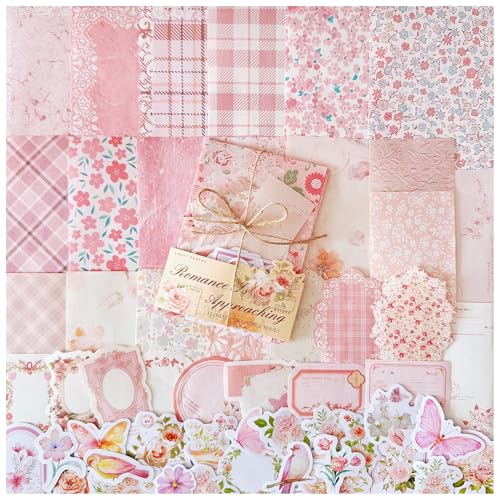
Layering scrapbook paper without turning the page muddy
Layering works when the sheets differ in scale and in value: one bold pattern, one small repeat, one plain or near-plain sheet between them. Same-scale patterns stacked directly on top of each other flatten into visual noise — that is the muddiness people blame on the paper when it is really the pairing.
The idea
Print never looks muddy on its own. It goes muddy when two patterns of the same scale sit edge to edge, because there is no line for the eye to follow and the two designs trade places as foreground and background.
Scale contrast, then value contrast
Large floral next to tiny dots reads immediately. Large floral next to medium floral reads as a smear. Once the scales are clearly different, check value — one sheet light, one mid, one dark. Two sheets of the same value will merge even when the patterns are different sizes.
The plain sheet is the one people skip
A solid or almost-solid sheet is not a waste of a layer. It is the pause between two loud sheets, and it is usually what makes the loud ones look intentional. A white-backed film sheet does this without adding another colour, which is why the film packs earn their place next to the floral ones.
How many layers is enough
Three. Beyond that you are stacking for its own sake and the page gains weight without gaining clarity. If a fourth layer feels necessary, something underneath it is in the wrong place — move that instead of covering it.
The process
Step by step
- 1
Sort your sheets into loud, quiet and plain
Three piles on the desk before you start. This takes two minutes and is the difference between a planned spread and an afternoon of moving paper around.
- 2
Cut three sheets to different sizes
Deliberately unequal: something close to full-page, something about two thirds, something a quarter. Equal-sized rectangles stacked look like a print error.
- 3
Rotate one layer
Turn the smallest sheet 90 degrees or a few degrees off square. It breaks the parallel edges that make a layered page look like a stack of cards.
- 4
Lift one corner
Leave a single corner or edge loose rather than gluing every layer flat. One raised edge gives the spread a shadow and therefore depth.
- 5
Check it in dim light
Step back and squint. If you cannot tell the layers apart, they are too close in value — swap the middle sheet for a plain one.
Small things that matter
- Keep every offcut. A 3 cm strip of the loud sheet is a perfect foreground element and costs nothing.
- Matte paper takes pencil and gel ink; glossy film does not. Write on the matte layers, and let the film sheets stay visual.
- Do not glue a busy sheet behind a busy sheet in the same direction. Flip one 90 degrees so the repeats run across each other.
- Store part-used sheets flat in a folder, not rolled. A curled sheet never sits flat once it is glued, and no amount of weight fixes it.
Made something with these?
Readers post their finished pages on the Journal wall — a photo and a line about how you built it is plenty.